
In my last post, I talked about how I stopped thinking in folders and started thinking in objects. How I rebuilt my knowledge system four times before landing on something that actually works. That post was the philosophy. This one is the architecture.
My entire system is split into four spaces: Atlas, Calendar, Efforts, and Pursuits. Each one has a clear purpose, a different relationship with time, and a reason to exist separately. I'm going to cover each space in its own post because otherwise this turns into a novel. Today: Atlas.
Why four spaces?
Before I get into Atlas, the split itself matters.
Most people dump everything into one workspace. Notes, projects, journal entries, movie lists, meeting notes, recipes. All of it in one place with tags or folders to sort things out. I did this too. It works until it doesn't.
The moment I started treating my knowledge system seriously, tagging things, linking things, building views and filters, the single-workspace approach collapsed. A journal entry about how my week went has nothing to do with my notes on distributed systems. A project I'm shipping has nothing to do with a restaurant I want to try. Putting them in the same space means every search, every filter, every view has to account for all of it. The noise drowns the signal.
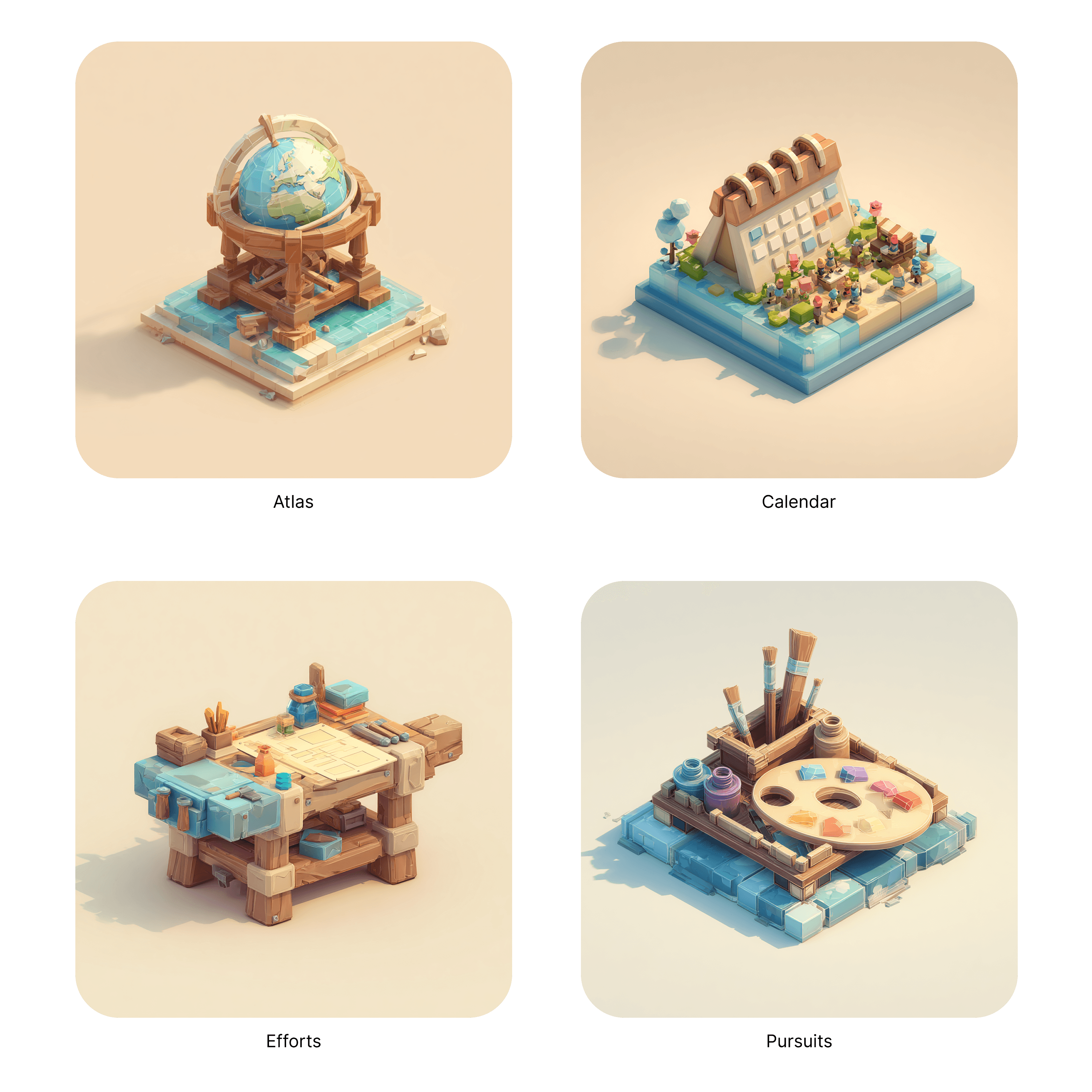
So I separated concerns. Four spaces, four intentions:
Atlas is knowledge. Timeless. The intention is to know.
Calendar is time. Time-bound. The intention is to focus.
Efforts is action. Timely. The intention is to act.
Pursuits is life. Timeless. The intention is to remember.
Each space has what I call an orienting lens: the filter through which everything in that space is understood. If something doesn't pass through the lens, it doesn't belong there. A book summary? Atlas. A deadline? Calendar. A project with tasks? Efforts. A travel destination? Pursuits. No ambiguity.
This isn't rigid for the sake of being rigid. It's rigid because the alternative is chaos with a search bar.
Welcome to Oblivion
My whole system is called Oblivion. The name is a nod to The Umbrella Academy. There's a moment in season three where the characters enter Hotel Oblivion, a gateway to another world entirely. That's what my knowledge system feels like. An infinite space that can always grow, always evolve. A threshold you cross into something bigger than what you had before.

Atlas is the first room in that hotel. The knowledge room. Where all factual knowledge lives. Not tasks, not schedules, not wishlists. Things I've learned, things I've read, things I want to understand better. It's timeless by design. Nothing in Atlas expires.
Atlas itself is structured around three sections: active sensemaking (where actual knowledge work happens), collections (people, companies, inspiration, the supportive stuff), and frameworks and structures (lenses I apply to my knowledge to view it differently).
Active sensemaking
This is where I spend most of my time in Atlas. It's where knowledge gets processed, connected, and deepened. Three systems live here: HEXCORE, the bookshelf, and resources.
HEXCORE
The name is a reference to Arcane. A show I was and still am completely in love with. When I needed a name for the core of my knowledge system, HEXCORE just felt right.
HEXCORE is a hierarchical navigation system. Five levels, each with a different purpose and a different level of stability. Think of it less like a filing system and more like a map with varying levels of zoom.
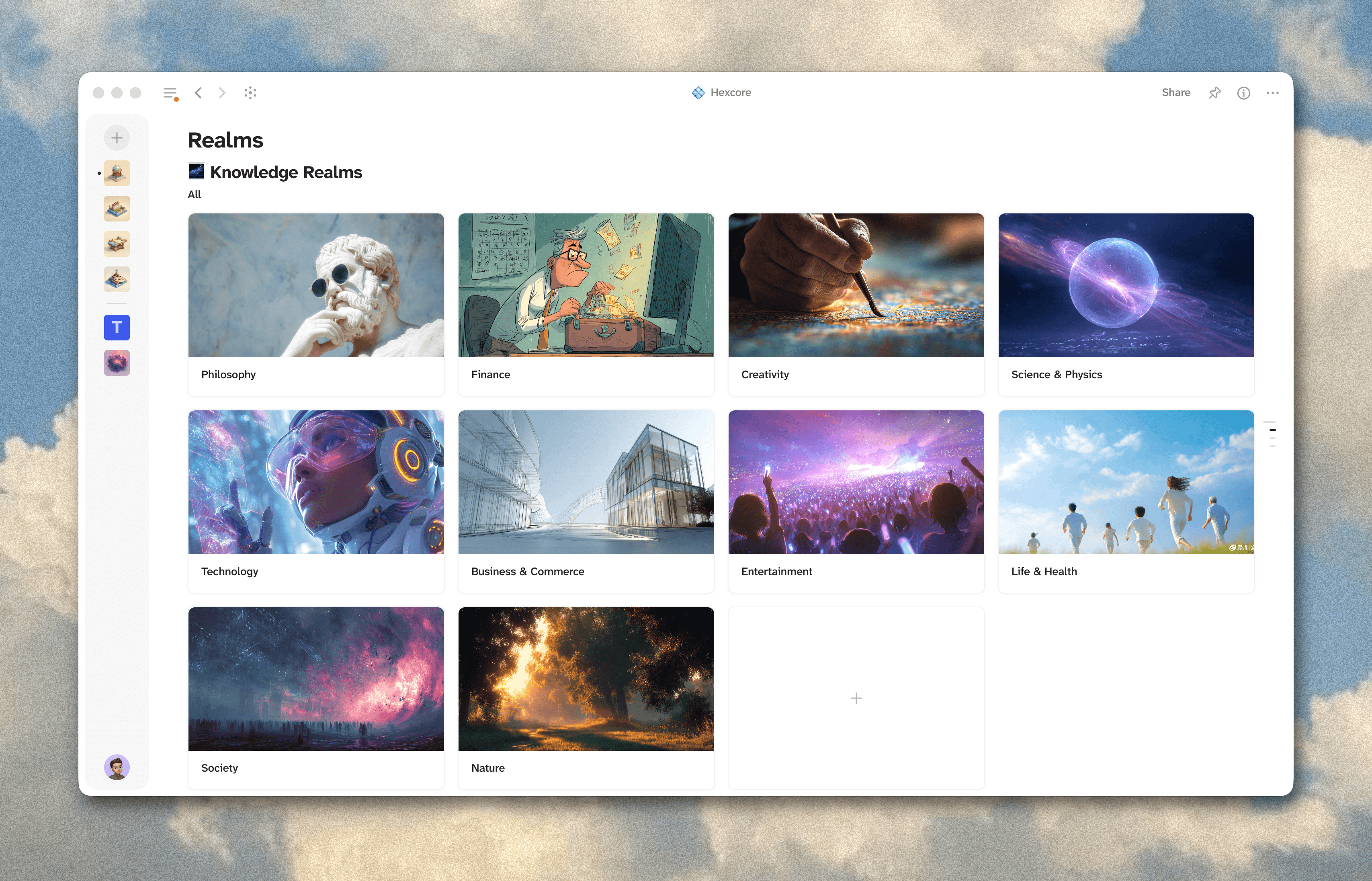
Realms sit at the very top. Broad, almost vague on purpose. My current realms are philosophy, finance, creativity, science and physics, technology, business and commerce, entertainment, life and health, society, and nature. I rarely create new ones and I've never retired one. They work as organizational structure rather than containing deep information themselves. The continents on the map. They tell you which part of the world you're in, but the interesting stuff happens at street level.
Domains are where it starts getting real. A domain is a knowledge area where sources converge into understanding. It has enough gravity to sustain ongoing work, and it always belongs to a realm. I've got somewhere between fifteen and thirty of them.
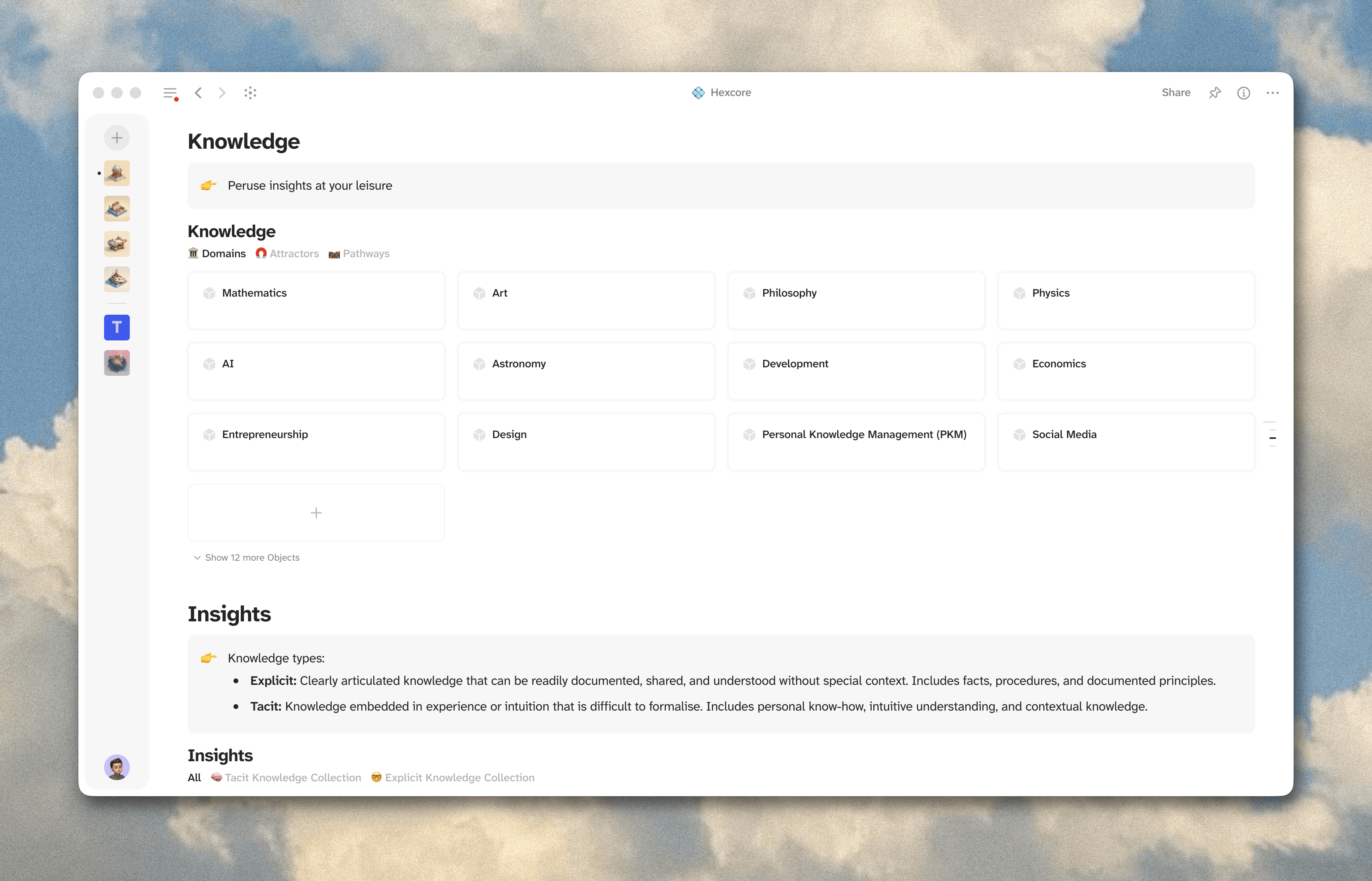
What I love about domains is that each one is a unique map of content. My generative AI domain contains a complete library of prompts I use, with outputs, details on which models I used, and notes on whether I found them effective. My SEO domain looks completely different. Different layout, different kind of content. But the essence is the same: a place where insights come together to form understanding.
Attractors are subdomain hubs. They draw you into a specific facet of a domain. An attractor has enough substance to be a focal point but not enough to stand alone, and it always links back to a domain.
The name is deliberate. Agentic AI is an attractor under my AI domain. AI as a whole is interesting, sure, but agentic AI is what pulls me in. It's specific, it's buzzing, it's worth investigating. That pull is what makes something an attractor. They also hold processing information: links I still want to check out, examples, experiments, anything that relates to that specific facet.
Pathways are explorations. Lines of inquiry that may or may not connect to anything yet. Content creation started as a pathway for me. It was a vague topic I was curious about but hadn't committed to. I'd save a link here and there, read a few articles, nothing structured. A pathway is an open thread I'm following to see where it leads. If it deepens, I promote it. If it fizzles, I archive it. No pressure.
Content creation eventually became its own domain. That promotion happened when two things converged: I'd accumulated enough sources and material that it needed its own space, and I'd started actually creating content myself. The learning and the doing hit a tipping point at the same time. That's how the system breathes. Things move upward as they earn their place.
Insights are the atomic level. Free-floating, bite-sized pieces of knowledge that can attach at any level. A domain, an attractor, a pathway, or just floating independently. I split them into explicit insights (facts, procedures, documented principles) and tacit insights (things that need more intuitive understanding and context to make sense of). An insight might link to an attractor, a domain, and a source all at once. They're stable once created.
The bookshelf
The bookshelf isn't literally a bookshelf. It's where any piece of knowledge material lives that I want to process. Blog posts, videos, podcasts, articles, books, webinars, research papers. Anything I'm currently reading through or want to get to.
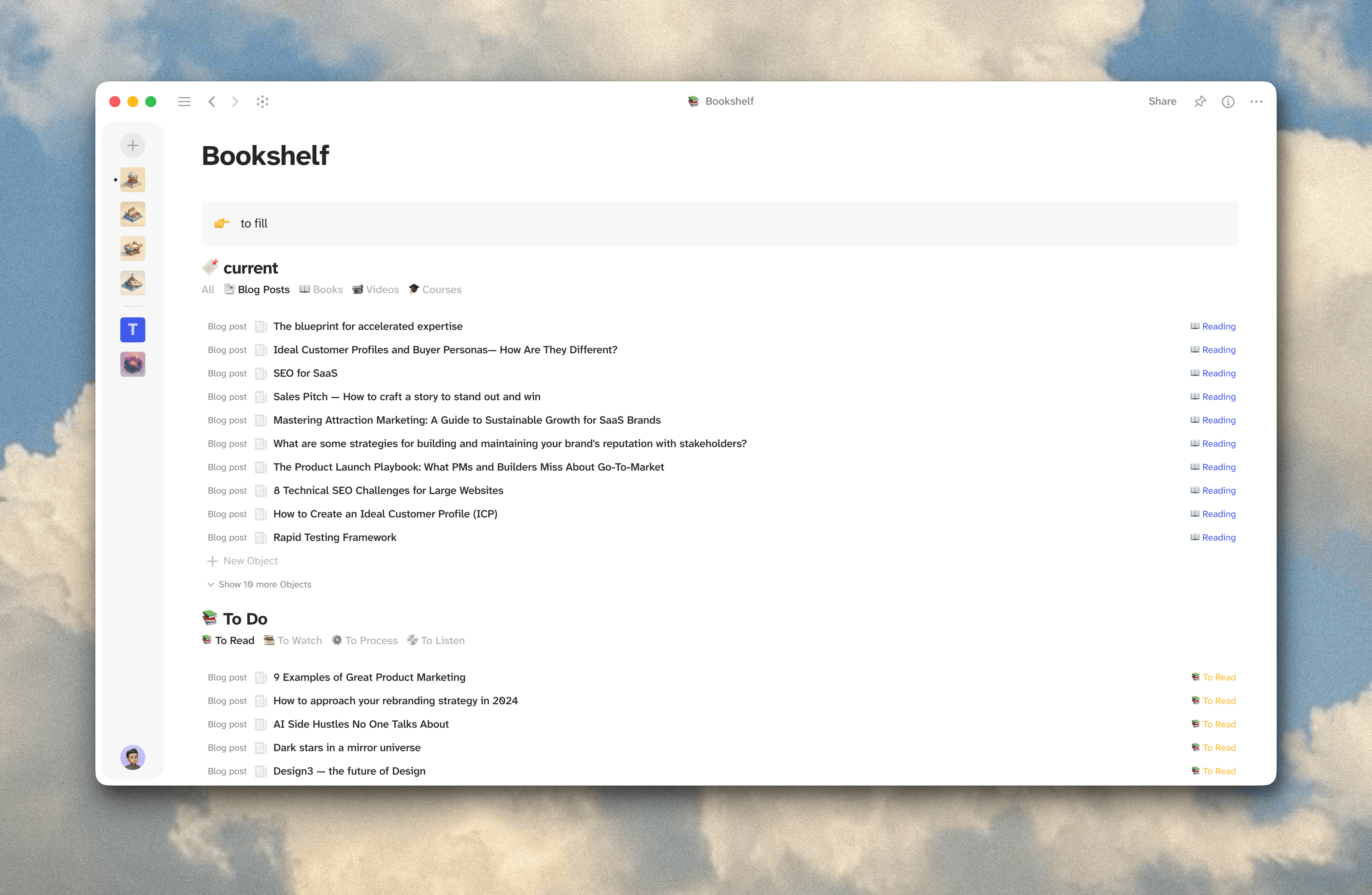
As I go through material, I make notes at the source level. If something is worth promoting, I push it up to the relevant attractor, pathway, or domain. And when I do, I link back to the original source. The system supports backlinks, so maintaining those connections matters. That's how you build a network instead of a filing cabinet.
Resources
Resources cover everything that supports knowledge work rather than being knowledge itself. Software tools and their evaluations. Providers that give access to assets like UI kits, stock material, font foundries. Each one gets its own object with metadata about what it is and whether it's worth keeping tabs on.
Collections
I'll speedrun through this because it's less about knowledge architecture and more about keeping track of things that support the rest.
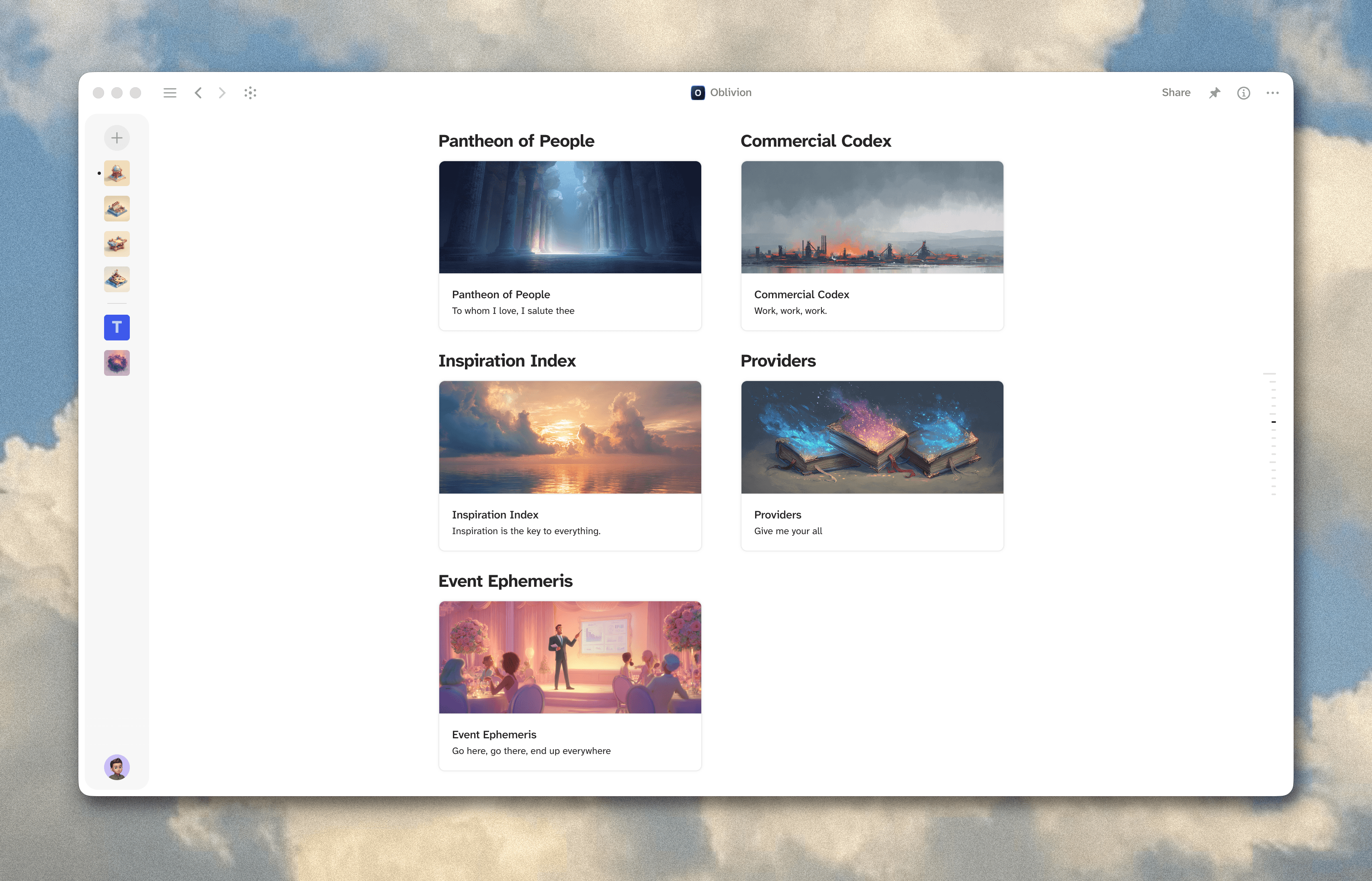
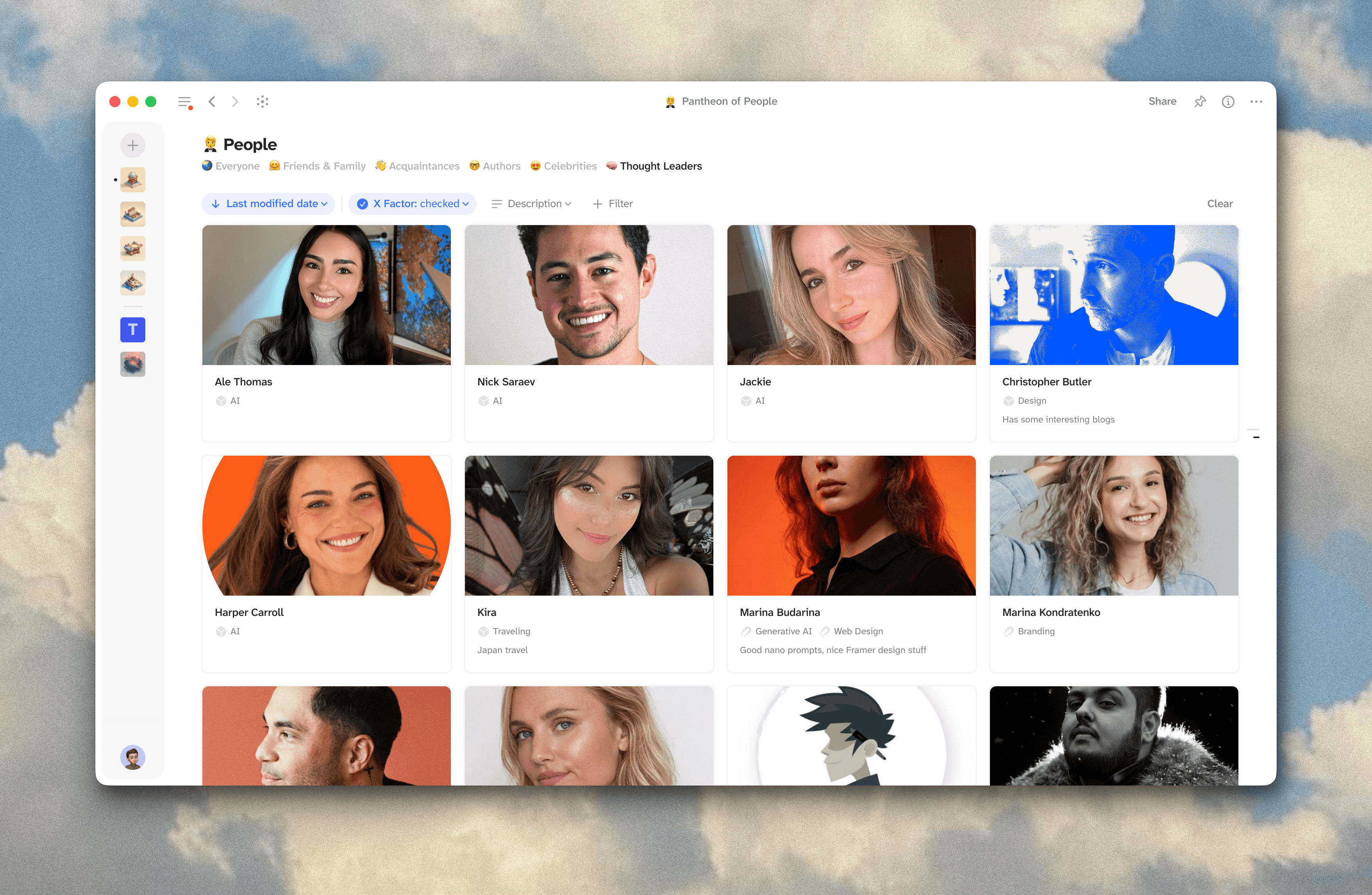
The Pantheon of People is my personal CRM for people I find inspiring. Designers whose work I want to follow, thinkers whose ideas keep showing up in my reading, friends and family with birthdays and notes. It links back into Atlas whenever someone's work connects to a domain or insight.
The Inspiration Index is where I store anything that inspires me on any level. A website, a photograph, a color palette, a blog post. Everything gets tagged to a domain or attractor. When I need inspiration for a specific project, say, designing a website for a medical service, I search for those tags and pull up everything I've ever saved that's relevant. Probably the most practically useful part of Atlas.
There's also a company tracker for organizations I find interesting and a section for knowledge providers: people and organizations that consistently put out courses, articles, or content worth following.
Frameworks and structures
This is the part of Atlas I'm most honest about: some of it works, some of it doesn't, and that's fine.
I have a working Zettelkasten setup. I've used it. It didn't really stick with me. It's there, it functions, and maybe I'll lean into it more at some point. Maybe I won't. I'm not going to force a methodology just because the PKM community swears by it.
The QCER framework (Questions, Claims, Evidence, Research) is more my thing. It's a structured, almost scientific approach to breaking down a topic properly. When I really want to do a deep analysis of something rather than just collecting notes about it, this is where I go. I don't use it daily, but when I do it's worth it.
Experiments is where I track ongoing trials. Things like "post on social media every Monday for six months." I log the experiment, the hypothesis, and my findings as I go.
The one I use most is Architect and Gardener mode. This comes from Ideaverse, an Obsidian-based PKM course I took a lot of inspiration from. The concept is simple: every item in my knowledge base can be tagged with a mode. When I come across something I want to build out or improve but I don't have the time right now, I tag it as an Architect build.
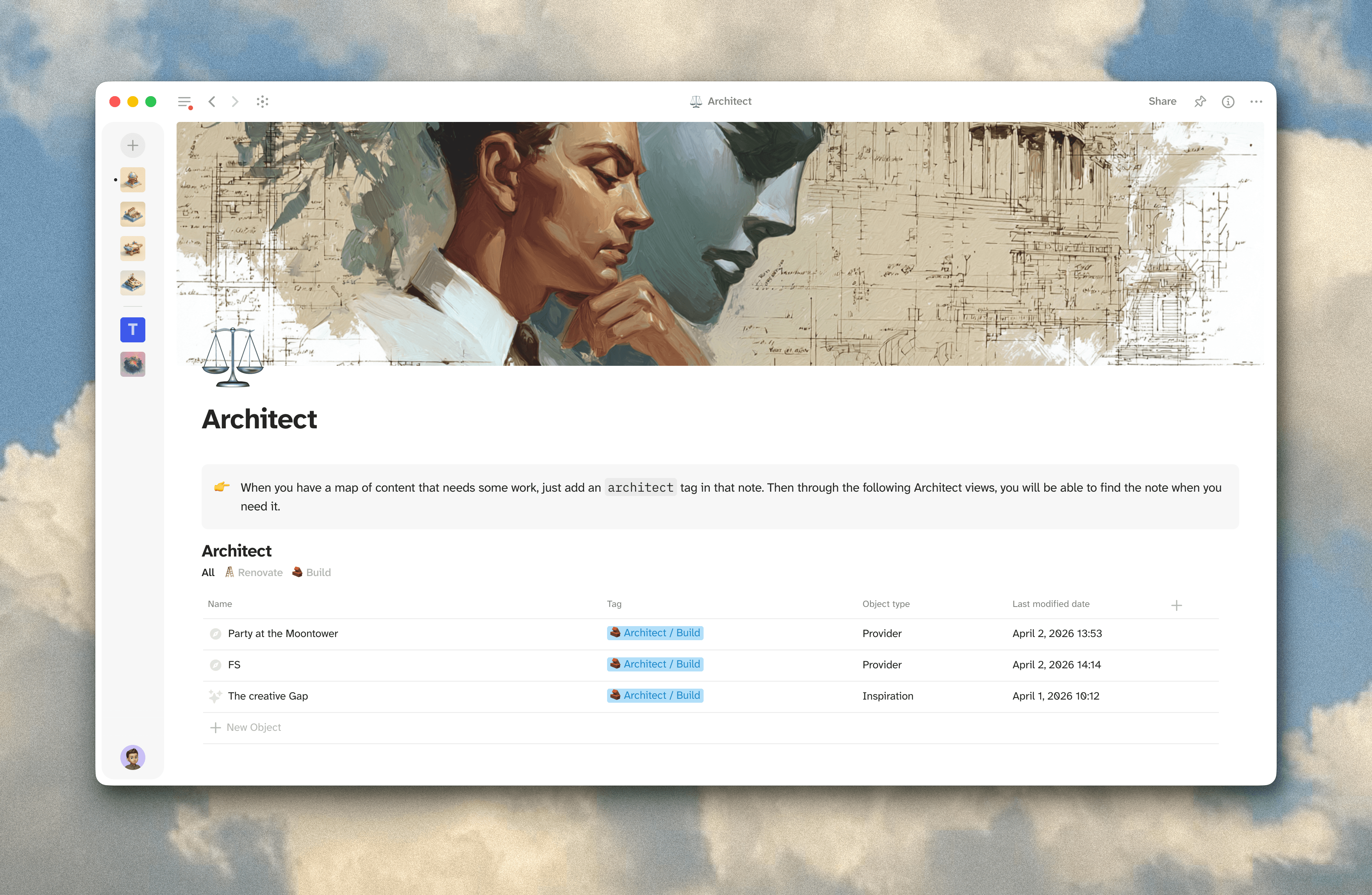
When I want to tend to something, nurture it, let it grow more organically, I tag it as a Gardener task. Later, when I'm in the mood to construct or to tend, I enter that mode. It applies a filter across the entire knowledge base and shows me everything I've flagged. No more "I should write this down somewhere so I remember to come back to it." Tag it and go.

The parking lot
I'd be lying if I said this all works seamlessly. The biggest friction point is intake.
Here's what actually happens. I'm scrolling LinkedIn or Instagram. I see something interesting. I grab the link, throw it onto a list I call the clipboard, and tell myself I'll process it later. Sometimes I do. Most of the time it migrates to what I've started calling the parking lot. A sprawling, unstructured pile of links, half-thoughts, screenshots, and saved posts. It's a mess.
The parking lot is guilt-driven maintenance. It piles up until I can't ignore it anymore, and then I sit down and go through every item, deciding whether it earns a place in the actual system or gets discarded. There's no elegant weekly review. There's no automated triage. It's me, a long list, and a Sunday afternoon.
I'm still figuring this part out. The system is solid once information is properly stored. Retrieval is fast, connections surface naturally, the structure holds. But getting things into the system with the right level of processing? That's the part I haven't cracked. And I think that's worth saying, because every PKM post you read online makes it sound like the author has it all figured out. Nobody does. The system is a living thing. And living things are messy.
Why this matters
There's a reason this series is called "Thinking in Systems" and not "My Favorite PKM Setup." Atlas isn't a note-taking app with extra steps. It's one part of a four-part system where each space handles something the others can't.
Atlas holds the knowledge that feeds decisions in Efforts. Calendar gives the time context that keeps Efforts on track. Pursuits holds everything that makes life worth living outside of work and learning. Take any one space away and the others start bleeding into each other.

That's systems thinking applied to personal knowledge. Not "where do I put this note?" but "what role does this information play in my life, and which part of my system is built to handle that role?"
I named the whole thing Oblivion because it's a gateway. You step through, and there's a world in there that keeps expanding. Atlas is where that expansion starts. With the simple act of trying to understand something and giving that understanding a place to live.
Next up: Calendar, where time meets intention.