
In the last post, I walked through Atlas, the knowledge room in my system. Timeless, structured, built for understanding. This post covers the opposite end: Calendar. The space where everything has a date, and that date is the point.
Calendar is the second space in Oblivion. Its orienting lens is time, its intention is to focus. If Atlas answers "what do I know?", Calendar answers "what happened, what's happening, and what am I becoming?"
It's also where things get more personal. Atlas is factual. Calendar is where thoughts and feelings hit the page. The raw stuff. The stuff that makes the rest of the system worth building in the first place
Why time needs its own space
Here's something I didn't understand for a long time: time-bound information and timeless information don't mix well.
A journal entry about a rough Monday doesn't belong next to my notes on typography. A weekly review doesn't sit naturally alongside a domain on distributed systems. They have fundamentally different purposes. One helps me understand the world. The other helps me understand myself, in context, at a specific moment.
Most PKM setups treat time as a property. You slap a date on a note and call it a day. But when time is the point, when the entire reason something exists is because it happened on March 12th or during the second week of January, then time isn't a property. It's the organizing principle.
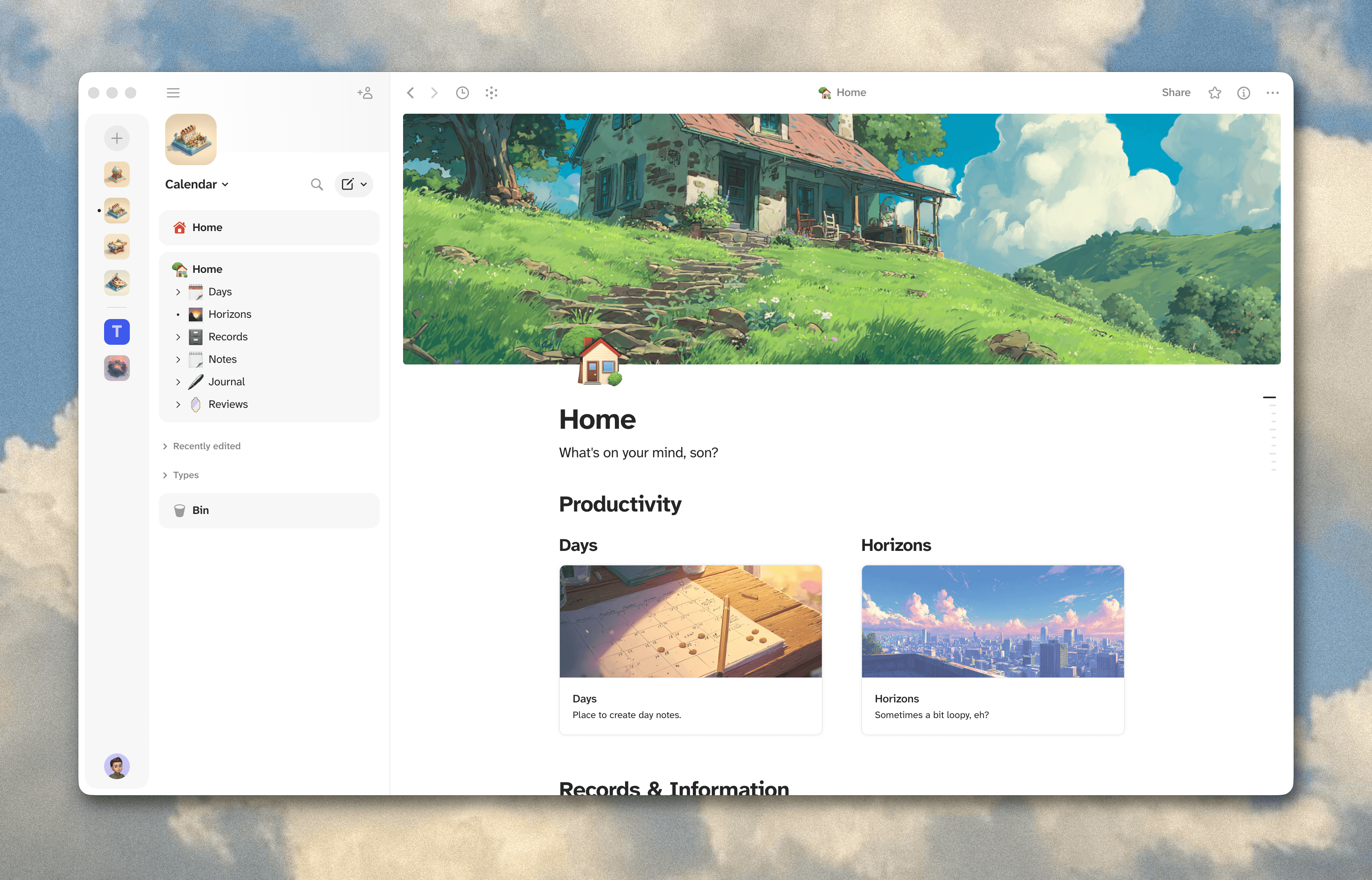
That's why Calendar exists as its own space. Everything in here has a temporal anchor. Remove the date, and the information loses its meaning.
I've divided Calendar into three sections, each covering a different intention: productivity, records and information, and growth.
Productivity
Day notes
The simplest unit in Calendar is the day note. One object per day, built from a template. Open it up, and there are fields for the good things about that day, the bad things, and notes for tomorrow. Five minutes, tops.
I don't write one every day. Some days nothing worth noting happens. Some days I forget. The system doesn't punish me for that. There's no streak counter, no guilt mechanism. But when I do fill one out, the next morning starts different. I open yesterday's note and there it is: what I was thinking about, what needs doing, what I shouldn't forget.
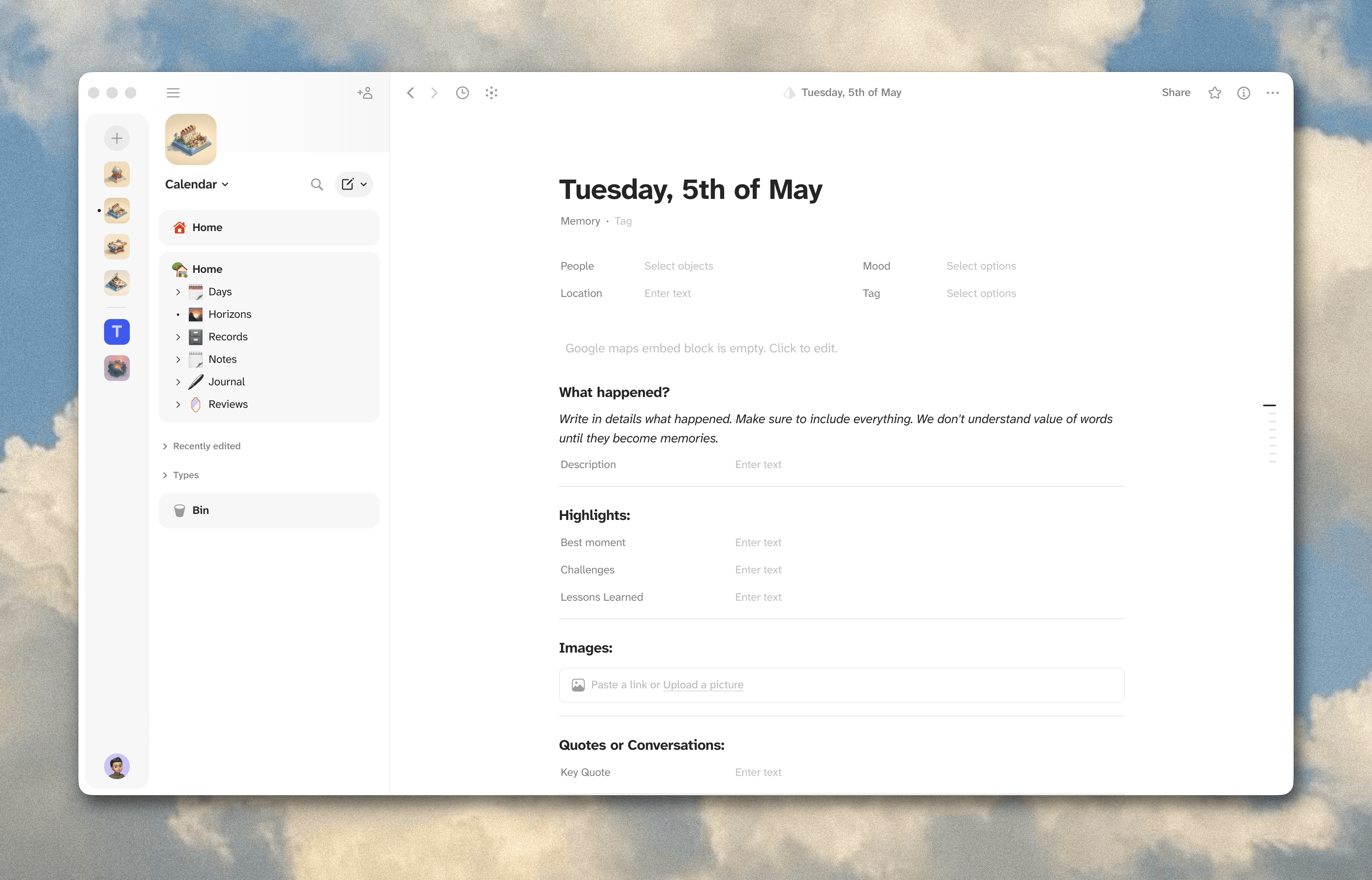
That last part matters more than it sounds. If you're constantly trying to hold small to-do's and half-formed thoughts in your head, it messes with you. Either you're stressing about not forgetting something, or you forget it and stress about what it was. Both are terrible. Writing it down at the end of the day clears the buffer. Tomorrow-you gets a clean start with a short briefing from yesterday-you.
Day notes are productivity-oriented. What got done, what needs doing, what to keep in mind. The emotional and reflective writing happens elsewhere. That distinction is intentional.
Horizons
Horizons are where Calendar turns into a planning tool. The idea is borrowed from how companies work with OKRs and KPIs, but applied to your personal life and deliberately less technical.
You work in loops. A large loop might span a quarter. A small one might span a week. Each loop has a focus: what am I trying to achieve in this period? The loops nest into each other. A weekly focus is informed by the monthly direction, which is informed by the quarterly aim. Zoom in for execution, zoom out for direction.

Think of it as giving your life a bit of structure without turning it into a spreadsheet. You could include metrics and targets. I don't. For me it's more about guidance. "This quarter, I want to get serious about content creation. This month, that means publishing three posts. This week, that means finishing the draft I started." That kind of cascading intention.
Here's the honest part: I don't consistently use all of these yet. The weekly cycle works well. Monthly is hit or miss. Quarterly happens but could be more deliberate. The structure is there. The habit isn't fully formed. Having the infrastructure ready means that when I do engage with it, I'm not building in the moment. I'm just showing up.
Records and information
Records
Records are the most practical part of Calendar. A record is anything semi-official that I need to keep track of: meeting notes, notes from events I've attended, decisions that were made on a specific day. Documents that need to exist somewhere and have a date attached.
The difference between a record and a day note is scope. A day note covers an entire day at a general level. A record is about one specific thing. "Client call about rebrand direction, notes on what was decided" is a record. "Tuesday was productive, had a good call and shipped two things" is a day note.
Notes
Notes are the catch-all. The random section. A note is a time-bound thought that doesn't have a suitable spot anywhere else in the system.
Not structured enough for a record. Not personal enough for a journal entry. Not broad enough for a day note. Not factual knowledge (Atlas). Not a task (Efforts). Not a life thing (Pursuits). Just a thought, tied to a moment, worth keeping.
I use these sparingly. Most things find a natural home in one of the more structured parts. But having a place for the in-between prevents those thoughts from cluttering up spaces where they don't belong. Every system needs a junk drawer, and I mean that affectionately.
Growth
Growth is the most personal section of Calendar, and the one I care about most. If productivity is about what you do, growth is about who you are. Two systems live here: the journal and reviews.
Journal
The journal is for reflecting and emotional writing. Not "what happened today" but "how do I feel about what's been happening?" It's where thoughts and feelings get processed with some depth.
There's overlap with day notes, and that's fine. The distinction is clear once you use both. A day note is productivity-oriented: what went well, what didn't, what's next. The journal is mental health and personal-oriented: how am I doing, what's weighing on me, what do I want to change?
Journal entries aren't necessarily daily either. They're more commonly tied to a stretch of time. I might write one on a Sunday about how the whole week felt. Or after a particularly intense few days. The rhythm is organic, not scheduled.
This is also the part of my system where AI explicitly has no access. I touched on this in my first post: I decide what an AI model gets to interact with. Journal entries are off-limits. They're not knowledge to be processed. They're thinking to be done. There's a difference.
Reviews
Reviews are templated check-ins that run at specific intervals. Two kinds: yearly and quarterly.
The yearly review is the heavy one. A whole list of questions about how I think I performed, what I want to focus on next year, what worked and what didn't. It's essentially high-level planning for your personal life. Broad strokes, sometimes more detailed, always honest.
I think yearly reviews are one of the most underrated exercises you can do. If you've ever felt adrift, like you don't quite know what you're doing with your life, or you're searching for direction, sitting down and doing one of these is genuinely clarifying. Not because the answers are easy, but because the questions force you to confront what you've been avoiding.
Quarterly check-ins are lighter. Less content, less pressure. More of an audit: how did the quarter go? Are the yearly goals still relevant? Does anything need adjusting? Think of it as a course correction rather than a full planning session.
How Calendar connects
Calendar doesn't exist in isolation. It's the temporal backbone that gives the other spaces context.
When I'm working on a project in Efforts, the relevant horizon tells me what this week's focus should be. When I'm processing knowledge in Atlas, a record might capture the moment a domain clicked into place. When I sit down for a quarterly review, it pulls threads from everywhere.
The key insight for me was that Calendar isn't a calendar. It's not about scheduling. My actual calendar lives in Google Calendar, where it should be. Calendar in Oblivion is about meaning in time. Not "what's happening at 3pm" but "what does this period of my life look like when I zoom out?"
What's working, what's not
Day notes are the biggest win. They're lightweight enough that I actually use them, and the payoff the next morning is immediate. The template helps. Five minutes of writing saves twenty minutes of trying to remember.
The growth section is genuinely valuable when I engage with it. The journal forces me to process things I'd otherwise just sit with. The yearly review I've done once, and it was one of the more useful things I've done for myself all year.
Horizons need work. I'm consistent at the weekly level, inconsistent beyond that. And there's a gap I haven't solved: the connection between Calendar and my actual daily workflow. My task management lives in Efforts, my scheduling lives in Google Calendar, and my reflection lives here. They inform each other, but they don't talk to each other automatically. I move information between them manually, which means sometimes I don't.
That's the next thing to figure out. Not a tool problem. A workflow problem.
Next up
Efforts, where planning turns into action. The space where projects, tasks, and goals actually get done. That's where the system proves whether it earns its complexity.